High-desert stinging insects establish colonies rapidly during the arid spring and summer months across Bernalillo County. In neighborhoods like the Foothills and Bear Canyon, western yellowjackets take advantage of…
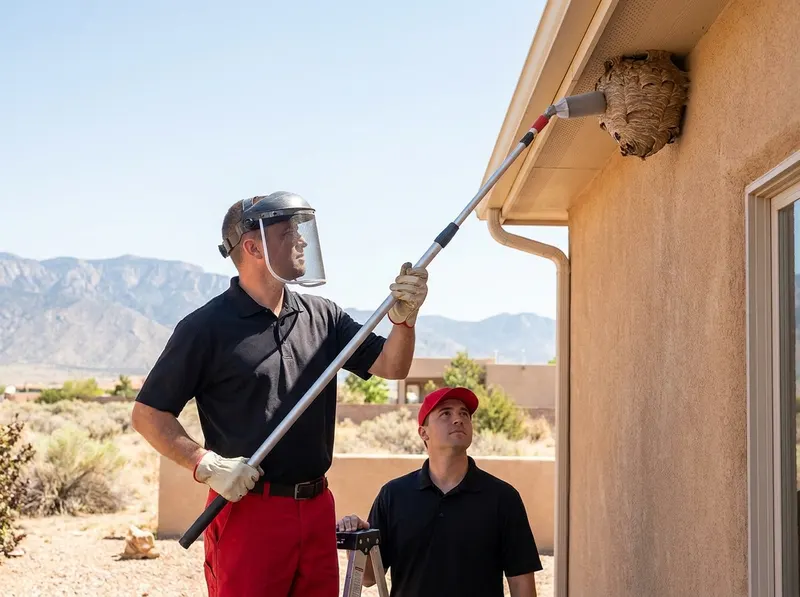
High-desert stinging insects establish colonies rapidly during the arid spring and summer months across Bernalillo County. In neighborhoods like the Foothills and Bear Canyon, western yellowjackets take advantage of dry soil fissures and retaining wall voids, establishing subterranean colonies that pose hidden hazards along footpaths. Closer to the Rio Grande basin in the North Valley and South Valley, paper wasps and mud daubers exploit increased ambient humidity and irrigated acreage, constructing hanging combs under architectural vigas, eaves, and shaded portals. Structures in Nob Hill and Huning Castle frequently experience nest development inside historic soffits, while homes in Taylor Ranch, Paradise Hills, and the Westside encounter aggressive nest building beneath stucco pop-outs and roof drip edges.
Store-bought pyrethrin aerosol sprays degrade rapidly under high ultraviolet indices and ambient summer heat exceeding 90 degrees Fahrenheit, frequently scattering defensive colonies rather than eradicating the brood. Standard do-it-yourself liquid sprays also lack the residual binding agents required to prevent returning foragers from reconstructing satellite nests on the same warm microclimate substrate. Stinging insect nest removal executes targeted physical and chemical containment using micro-encapsulated formulations designed to resist Albuquerque's arid wind exposure, followed by the complete scraping and mechanical disposal of the nest structure. Residual formulations once dried bind to non-porous stucco, brick, and rough-sawn timber, establishing a durable perimeter shield that remains inert for domestic cats and dogs.
Decision guidance relies on colony accessibility and entry-point proximity. If an aerial paper wasp nest measures under 3 inches and hangs openly on an isolated perimeter fence line, localized physical detachment after dusk provides adequate resolution. If colonies inhabit structural weep holes, attic vents, subterranean burrows, or measure larger than 4 inches near doorways or evaporative cooling units, professional extraction becomes necessary. Attempting to seal entry holes before eliminating internal cavity nests forces aggressive workers inward through drywall voids, recessed lighting canisters, and interior HVAC ducts, escalating indoor sting exposures.
Every job gets a firm, written price after a free on-site visit.
Tell us about your stinging insect nest removal job in Albuquerque and we'll send a clear, written quote, usually the same day.
 Nexaro Pest Removal