High-desert conditions in Bernalillo County create unique nesting behaviors among invasive and native ant species. During hot, arid dry spells, colonies drive subterranean tunnels deep beneath concrete foundation…
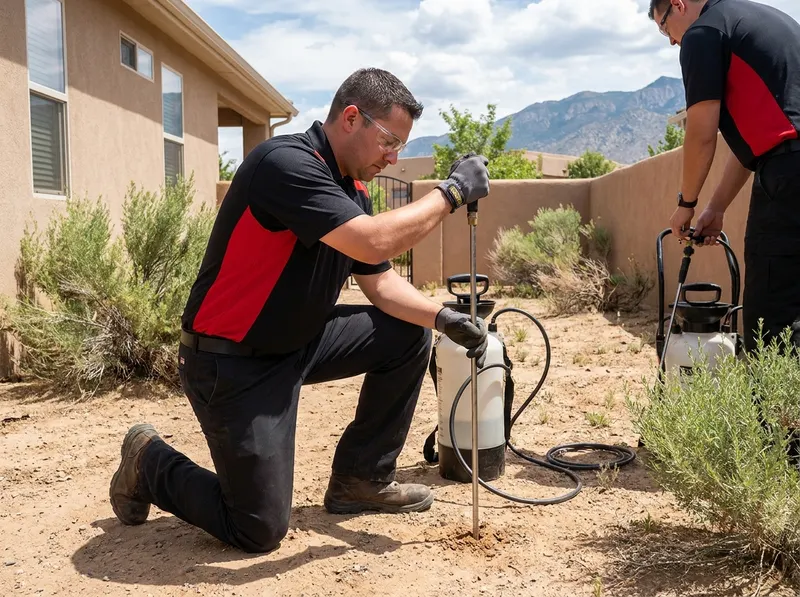
High-desert conditions in Bernalillo County create unique nesting behaviors among invasive and native ant species. During hot, arid dry spells, colonies drive subterranean tunnels deep beneath concrete foundation footings, flagstone patios, and native xeriscaping to access underground utility line condensation. Standard topical pyrethroid sprays break down rapidly under Albuquerque's high ultraviolet radiation index and dry western winds; these surface sprays also cause "budding," a defensive mechanism where a single colony fractures into multiple satellite colonies throughout the structure. Professional soil treatments utilize non-repellent liquid micro-emulsions bonded directly into the top 2 to 6 inches of granular earth. Foraging worker ants walk through the treated subterranean zone without detection, transferring the active non-repellent compound back through the brood chambers directly to the queen via grooming and shared food.
Properties situated along the Rio Grande basin, including the North Valley, South Valley, and mature acreage near Huning Castle, encounter heavy odorous house ant pressure drawn to sub-surface irrigation channels. Conversely, arid foothill and mesa properties across Taylor Ranch, Paradise Hills, the Westside, Bear Canyon, and the Sandia Foothills face expansive red harvester and pavement ant mounds. Harvester ants clear vegetative zones up to 9 feet in diameter, burrowing 6 to 10 feet into compacted caliche subsoils. For localized small surface trails on a patio, topical micro-granular ant baiting is appropriate; however, once ants penetrate weep screeds or interior structural wall voids, pressurized liquid soil injection around the foundation perimeter becomes mandatory. The trade-off involves application footprint: sub-surface soil saturation requires establishing a contiguous 3-foot horizontal and 1-foot vertical barrier strip along the building perimeter, requiring specialized injection rods rather than a fast topical aerosol spray.
Execution follows an objective, sequential protocol: 1. Identification of the ant species and mapping of structural trailing trails along foundation edges. 2. Mechanical displacement of surface river rock or bark mulch away from the foundation masonry. 3. Sub-surface rod injection of non-repellent termiticide/insecticide liquid emulsion into exterior foundation soil beds at calibrated flow rates. 4. Targeted injection of nesting galleries positioned under sidewalk slabs, pavers, or stone retaining walls. 5. Replacement of protective landscaping aggregate over the treated perimeter band. Once the soil injections bind to the earth particles and dry completely, typically requiring 60 minutes in Albuquerque's low relative humidity, the residual barrier resists wind erosion, UV exposure, and heavy rain wash-off, remaining inert and undetectable to indoor pets.
Every job gets a firm, written price after a free on-site visit.
Tell us about your ant colony elimination and soil treatment job in Albuquerque and we'll send a clear, written quote, usually the same day.
 Nexaro Pest Removal